Setting FFMPeg options for Streaming and Video Conversion
Need help? Start with User FAQ & Troubleshooting. If streaming isn’t working, start with Streaming first checks. If converting files, see Video File Conversion. If tools are missing, see Tools & Dependencies.
This page is for advanced users who want to tune Stream to 3D’s FFmpeg settings for streaming and file conversion.
You can control a range of aspects of the streaming and conversion process via the “FFMPeg Options” fields in the “Settings/Streaming” and “Settings/Conversion” menus. See screen shots below:
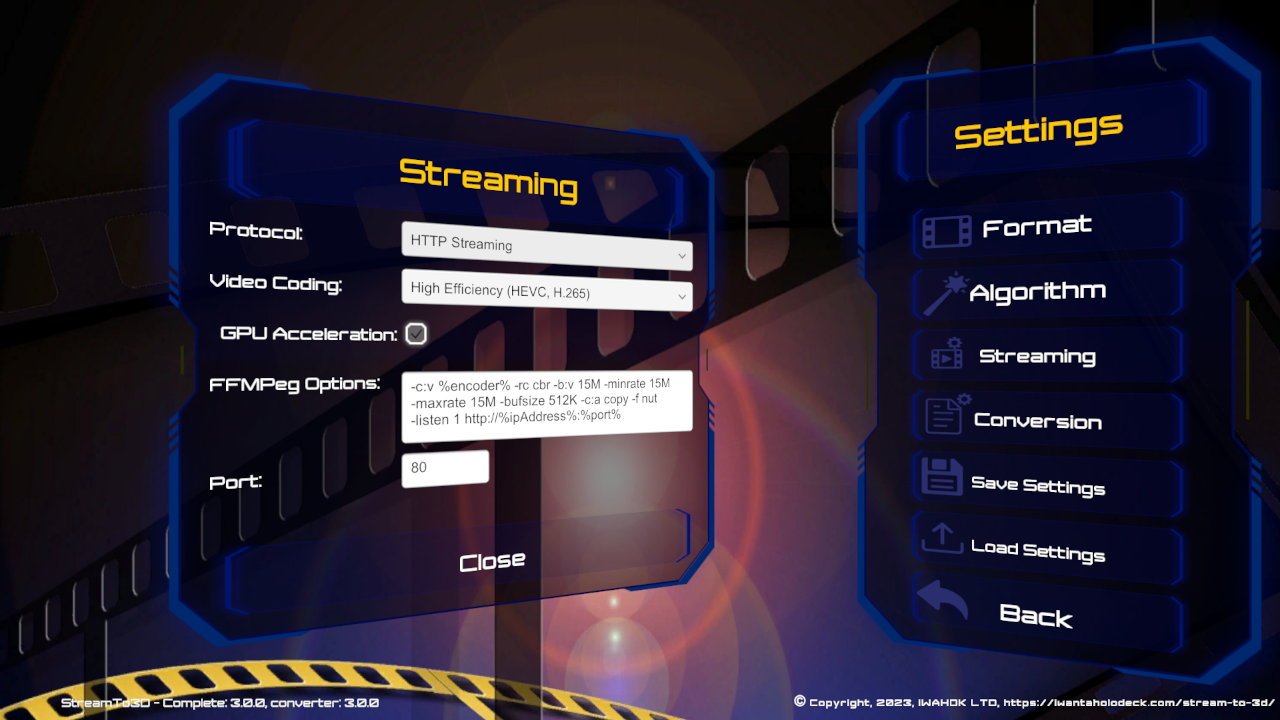
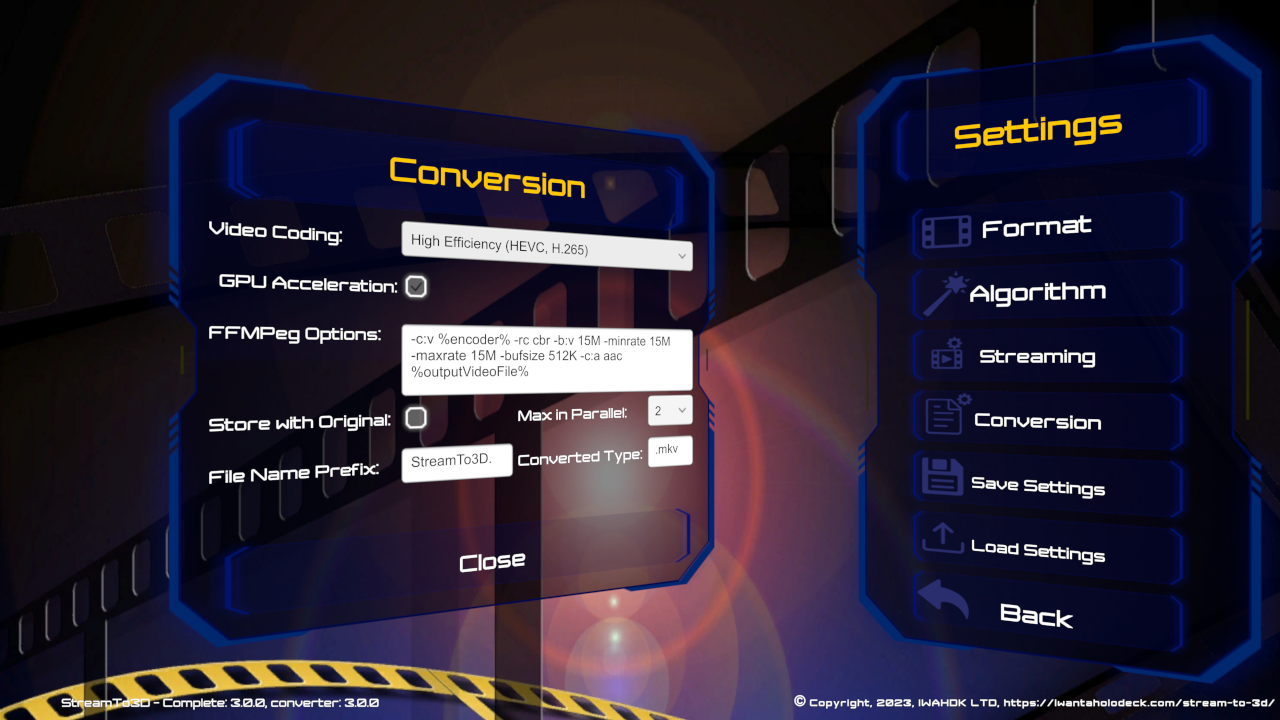
The “Video Coding”, “GPU Acceleration” and “FFMPeg Options” used by Stream to 3D can be configured independently for each streaming protocol, as well as for video conversion. To configure the settings for a specific streaming protocol, make sure the relevant protocol is selected in the “Protocol” drop-down before you begin.
The “Video Coding” drop-down lets you choose the video encoding format for your streamed or converted videos. You can choose between “Advanced (AVC, H.264)”, “High Efficiency (HEVC, H.265)” or apply your own “Custom FFMPeg Options”.
The “Custom FFMPeg Options” selection requires advanced knowledge of FFmpeg and its configuration. If this option is selected, Stream to 3D will not automatically specify the video encoding options to FFmpeg. In this case, the encoding options should be set in the FFMPeg Options text area together with the other options (see below). Stream to 3D will set the %encoder% variable (shown in the “FFMPeg Options” text area) to an empty string if this option is selected.
The Graphics Processing Unit (GPU) “GPU Acceleration” tick box determines whether your GPU hardware will be used to encode your converted videos, or whether encoding will be performed in software on the CPU.
GPU encoding is substantially faster, but software-based encoding can yield better quality. Stream to 3D will auto-detect your GPU. If you have either an NVIDIA or AMD GPU, then “GPU Acceleration” will be enabled by default. You can change this by unticking the box, so that software-based encoding is used instead.
Note that the maximum output resolution for NVIDIA H.264 GPU-accelerated encoding is 4096×4096 pixels. For NVIDIA H.265 GPU-accelerated encoding, the maximum output resolution is 8192×8192 pixels. If you want an output video with H.264 encoding that is greater than 4096×4096, disable GPU acceleration in settings or use H.265 encoding instead.
The “FFMPeg Options” box provides the opportunity to further customise FFmpeg options. For example, you can adjust bitrate and audio format. For further reading, see the FFmpeg documentation here.
Click here to go to the Configuration Guide.